From the Field Journal of Ambrose Penhallow
The Sky Whale
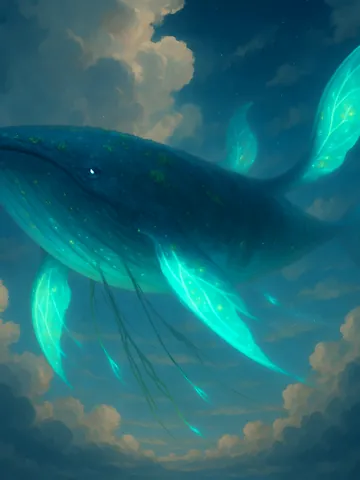
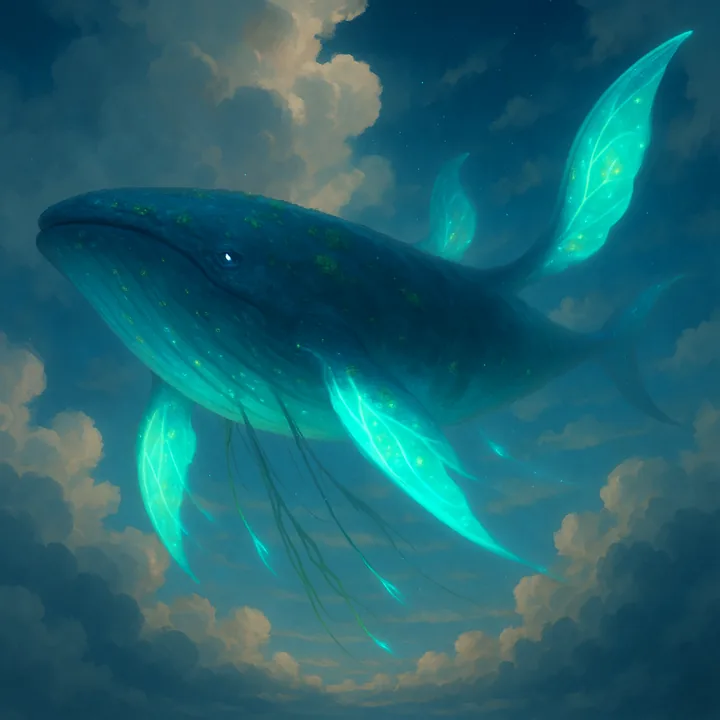
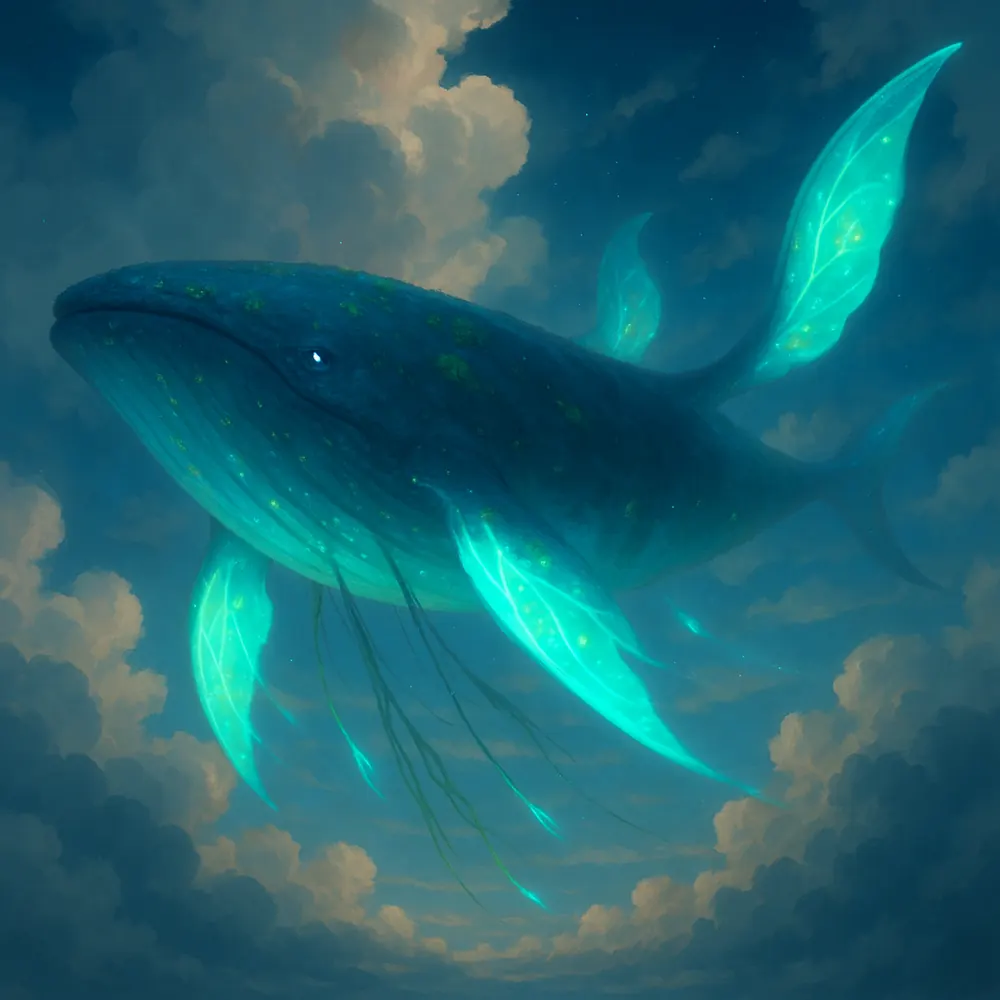
The first time I saw a Sky Whale I mistook it for weather. A long, dark shape slid out of a cloudbank above the High Canopy, and only when its fins lit up (a soft, sea-green glow, like lanterns seen through river water) did I realize the “storm front” had an eye. Its body is a deep teal flecked with tiny pale spots, almost like stars, and long ribbon-like tendrils trail from its belly and fins, swaying as though the creature were still underwater.
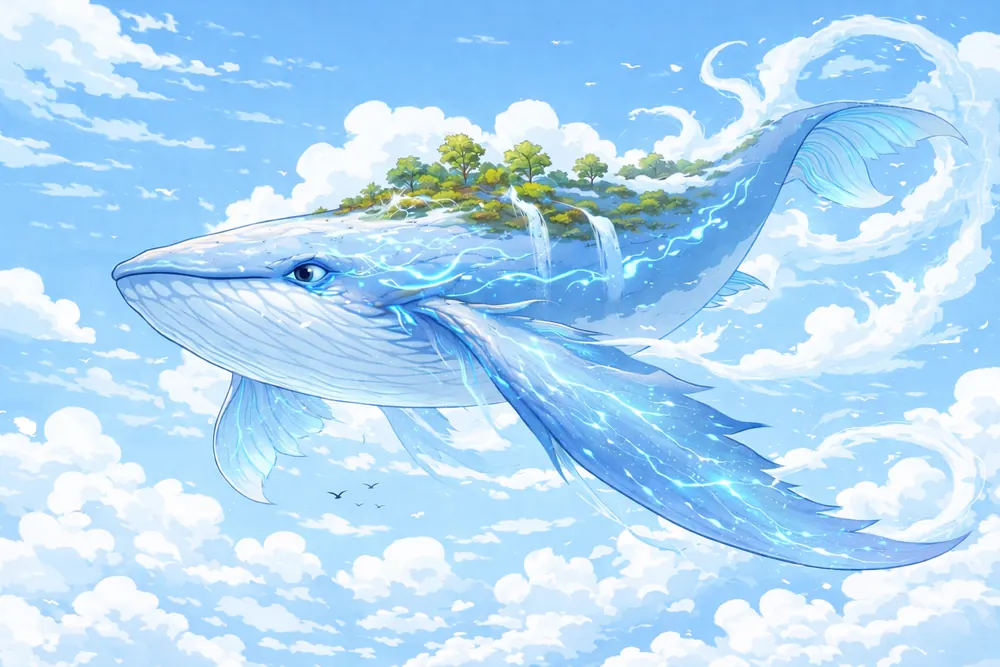
They live entirely in the upper air, drifting in slow pods along routes that seem to follow the storms. The oldest are so vast that small forests grow along their spines: I have it on good authority that one particularly ancient whale supports a grove of fruit trees, two nesting colonies of swallows, and a hermit who refuses to come down.
The Mystery of the “Long Song”
On still nights, if you are high enough, you can hear the whales sing. It is a sound so low that you feel it in your teeth before your ears catch it. What puzzles me is that the song does not seem to be for other whales. Pods sing when there is no other pod for a hundred leagues.
The Ventara, who sing to the whales during migration, believe the whales are answering them, that the song is a duet started long ago and simply never finished. A Centaur matriarch I met in the foothills scoffed at this. She claimed the whales are singing to the ground, calling to something buried that they lost during the Great Split, and that her clan’s horns were first carved to imitate the sound. Neither could tell me what the whales were saying. Both were very sure I was wrong to ask.
On the Matter of Bonding
You cannot bond with a Sky Whale from the ground. This sounds obvious, but I wasted a full month learning it. They do not come down. You must go up.
The Ventara are the only true experts, and their method is music. They fly alongside a migrating pod for days, singing in shifts so the song never stops, until one whale (always one, never the whole pod) slows and lets the singers land on its back. A Ventara elder told me the whale is not choosing a rider; it is choosing a voice. If your voice fits the song, you may stay. If it does not, the whale simply rolls, and you had better have wings.
I do not have wings. I was carried aloft in a basket by six very patient Ventara and set down on the broad back of a young bull, where I sang a Midlands drinking song as earnestly as I could. The whale did not roll. The elder later admitted this was because it was asleep.
Observed Magical Variations
Sky Whales are sky creatures to the marrow, but each pod I have tracked seems to have absorbed something of the clouds it feeds on.
Deep teal body flecked with pale spots; fins that glow sea-green at night.
The common migrating whale. Eats storms whole and leaves calm, rain-washed skies in its wake.
Pearly white with golden fins; its belly tendrils catch the sunrise.
Only seen at first light. The Ventara consider it extraordinarily lucky to sleep beneath one, which explains the crowds.
Pale blue-grey, crusted with rime along the back; breath falls as snow.
Drifts over the northern peaks in winter. I watched one sneeze and bury a mountain village under a fortnight of snow.
Ambrose PenhallowLorekeeper, Midlands Grand Academy