From the Field Journal of Ambrose Penhallow
The Landshark
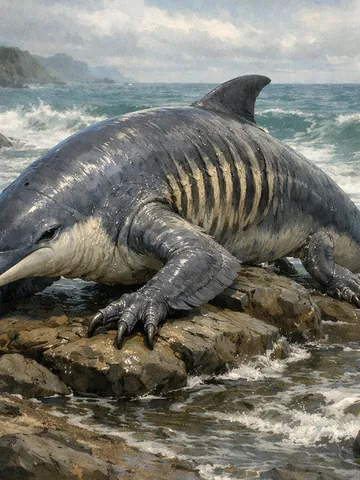
There is no dignified way to describe the first time you see a dorsal fin cutting through a wheat field. It glides along above the stalks, smooth and unhurried, exactly as it would in open water, and every instinct you possess tells you that you are on dry land and therefore safe. You are not. Beneath that fin is a shark on four stubby, powerful legs, waddling in a rolling, swimming motion that looks absurd right up until it accelerates.
They favor the long grasslands and plains, where the soil is deep and soft and carries a footstep like a drumskin. Most of the ones I have seen were the size of a large hound, and they hunt the tall grass the way their cousins hunt the shallows: patrolling in lazy loops, fin up, waiting for something to make a careless noise.
The Mystery of the “Grass Wake”
Herders on the plains swear that a Landshark leaves a wake. Not tracks, mind you, but a long ripple in the grass that lingers behind it for an hour or more, as though the field were water still settling. I have seen these ripples with my own eyes, and I have walked straight through one and felt the ground give slightly underfoot, like stepping onto a raft.
The Centaurs of the Amberhoof clan insist this is simply the Earth magic in its body loosening the soil as it passes, and they use the wakes to track herds of them for miles. A Hesskari merchant traveling with their caravan had another theory entirely. He claimed the Landshark remembers the sea so fiercely that it drags a little of the ocean along with it wherever it goes, and that if you put your ear to a fresh wake, you can hear surf. I did put my ear to one. I heard a beetle. The Hesskari said I was listening wrong.
On the Matter of Bonding
The first rule of Landshark bonding is that you cannot sneak up on one. Every scroll I have read on the subject suggests a quiet approach, and every scroll is written by someone who has clearly never met a Landshark. It feels you through the soil long before it sees you. The Centaurs, who are the acknowledged experts, do the very opposite: they approach at a full gallop, hooves pounding, and stop dead a few lengths away.
The idea, as their war-mother explained it, is to be loud and honest. A Landshark judges you by your footfall. A hesitant, shuffling step reads as prey. A steady, heavy, unafraid stride reads as something worth respecting. She made me practise walking in a circle for an entire morning while she shouted “Heel first! Mean it!” at me. I do not believe I ever meant it enough.
Once bonded, a Landshark is a superb companion for any traveler crossing open country. It will patrol your camp at night in slow circles, fin just above the grass, and nothing gets within a hundred paces without it knowing. It is less superb if you are a light sleeper, as they snore with their entire body.
Observed Magical Variations
The ground a Landshark swims through seems to shape it as surely as the sea once did.
Mottled brown and green hide; a stout, ragged fin like a worn plough blade.
The common plains breed. It can sink fully into loose soil and wait there for days, fin hidden, until something steps on it.
Pale sandy skin that shimmers with heat haze; a tall, curved fin.
Found in Hesskari desert country. The sand behind it is often fused into glass, which the Hesskari collect and sell as “shark-pearls” to gullible humans. Yes, I bought one.
Slick blue-grey skin and wide, webbed feet.
Prefers marsh and flooded meadow, where it cannot decide whether it is on land or in water and appears to enjoy the confusion enormously.
Ambrose PenhallowLorekeeper, Midlands Grand Academy