Beyond the six great peoples lie the rare and reclusive folk of the margins — keepers of forgotten magic, ancient bonds, and paths no common traveler walks.
In Mythica, these peoples are uncommon and mysterious — scattered across the world, reclusive by nature, and rarely encountered in settled regions. But those who seek them out and earn their trust gain access to rare forms of knowledge, ancient creature bonds, and alternative magics that no school or guild can teach.
The Trickster Folk — Forests, Ruins & Forgotten Places
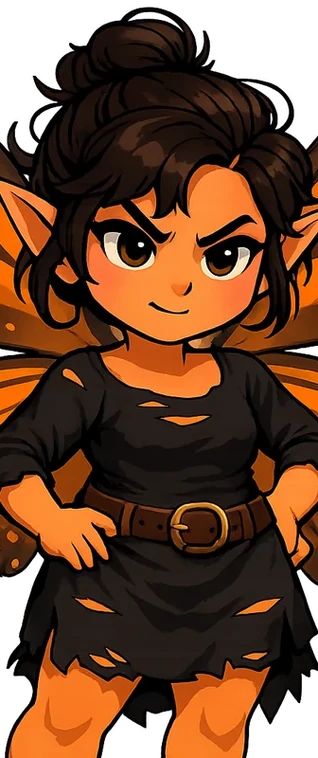
Redcaps are small, sharp-toothed folk with red-stained caps, thorny limbs, and eyes like glinting coins. They dwell in old ruins, hollowed-out trees, and forgotten tunnels where humans and creatures once clashed. Fast, clever, and always grinning, they love objects that glitter — not because they're valuable, but because they might be useful in a prank. Their society is based on trickery-as-truth. Deception is a language, and if you can survive a joke, you've earned their respect.
They trade in riddles, shiny items, and knowledge about elusive Mythica creatures. Their rituals often involve blood (usually from small cuts), laughter, and smoke. Redcap bonding is secretive — conducted in hidden locations through rites that outsiders are rarely permitted to witness. Other races often see them as pests or thieves, but seasoned tamers know: if a Redcap likes you, you're about to learn something very rare — or very weird.
The Mask People — Swamps, Bogs & Sacred Wetlands
The Wika are swamp-dwellers with smooth, bark-colored skin and wide masks that never leave their faces. They are tall, slow-speaking, and eerily graceful — their presence feels dreamlike, like the air itself goes still when they arrive. The Wika believe identity is fluid. They wear masks not to hide, but to become. Each mask is carved with sacred symbols representing the creature spirits they study, and an elder Wika may carry dozens of masks over a lifetime.
They live in small floating settlements and only allow outsiders to visit during mist festivals or after vision quests. Their magic is subtle — illusions, dreamwalking, and communing with spirits no one else can see. Most outsiders find them creepy or unknowable, dismissing them as hermits or cultists. Those who've trained with the Wika, however, often come back changed — speaking softly, dreaming deeper, and bonding with creatures no one else dares approach.
The Bonecrafters — Remote Wilderness, Caves & Ruins
Hags are stooped, long-limbed spellbinders cloaked in stitched skins, feathers, and bone. Often mistaken for monstrous individuals, they are in fact a race of ancient women — once wise caretakers of nature's harshest corners, now twisted by centuries of bitter magic. They live in isolated dens or covens of three, teaching each other bloodbinding and rune-carving not out of kindness, but to pass down power.
Their bond with Mythica creatures is based on dominance. They see creatures as forces to be commanded, not loved — and their dens are guarded by malformed beasts and bone wards. Nearly all other races fear Hags. They're seen as witches, villains, or predators, and sometimes rightly so. But for those desperate enough to make a bargain, the Hag might be the only one with the answers that no school or guild will offer.
The Deep Drifters — Ocean Zones, Reef Grottos & Submerged Ruins
Mermaids in Mythica are not elegant singers with seashell jewelry — they are sleek, colorful, fish-bodied beings with scaled torsos and large black eyes. Some shimmer with koi-like beauty, while others resemble deep-sea predators with leathery hides and luminous spots. Their fishlike lower bodies include more of their torsos within the fish anatomy, making them more creature-like than humanoid. They don't speak Common and rarely stay above water for long.
Mermaids don't build. They drift, they play, they watch. Their culture resembles the pods of dolphins — playful but hard to study, following old migratory patterns and seasonal creature songs. They communicate with color shifts, currents, and clicking sounds. Their bonding style is synchronized movement and emotional mirroring — a mermaid will approach a creature by matching its rhythm until the two are indistinguishable. They are seen as curiosities by most races: too alien to fear, too elusive to trust.
The Voice Callers — Rocky Shores, Kelp Forests & Shipwreck Zones
Sirens are humanoid water-dwellers with elongated limbs, slick seaweed-like hair, and soft, hypnotic voices. They live in coastal ruins, singing to the tides and whispering to Kelpies, whom they treat as both companions and partners. Sirens see drowning not as murder but as art — a kind of release. Most don't intend harm; they simply cannot help themselves once the song takes hold. Their society centers on voice control, games of mimicry, and dominance through allure.
They respect those who resist their pull — and despise those who surrender too easily. Siren creatures follow out of obsession or carefully cultivated fear rather than love, making them unpredictable outside the Siren's presence. Traveling near their waters means learning to swim — or learning to sing back. Those who can match a Siren's note are often extended a rare courtesy: a brief, genuine conversation.
The Shapeshifters — Forests, Plains & Coasts
Born of the same root people, these shapeshifters chose different paths. The Skinwalkers live among forests and mountains; the Silkies dwell near oceans and coasts. Both are tall, quiet, and often seen wearing the hides of the creatures they become. Some remain in animal form for years at a time. Their culture is deeply animistic — they believe humans were never meant to dominate, only blend. They mark milestones not with stone or speech, but with transformation.
They build homes of woven grass and hollowed trees, move often, and rarely speak to outsiders. Their bonding style is empathy-based: they become like the creature to understand and connect — spending time in animal form alongside it, matching its rhythms, until the boundary between bonded and bond dissolves. To other races, Skinwalkers and Silkies are both feared and romanticized. But when a great beast needs calming — or avenging — these are the first ones the wise seek out.