From the Field Journal of Ambrose Penhallow
The Thunderbird
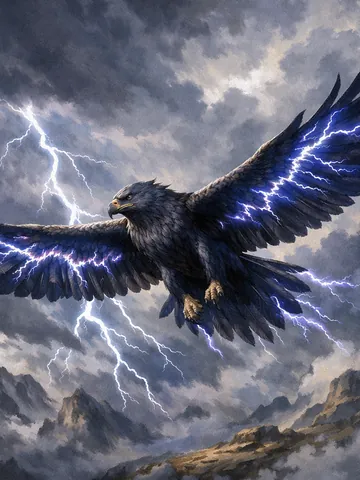
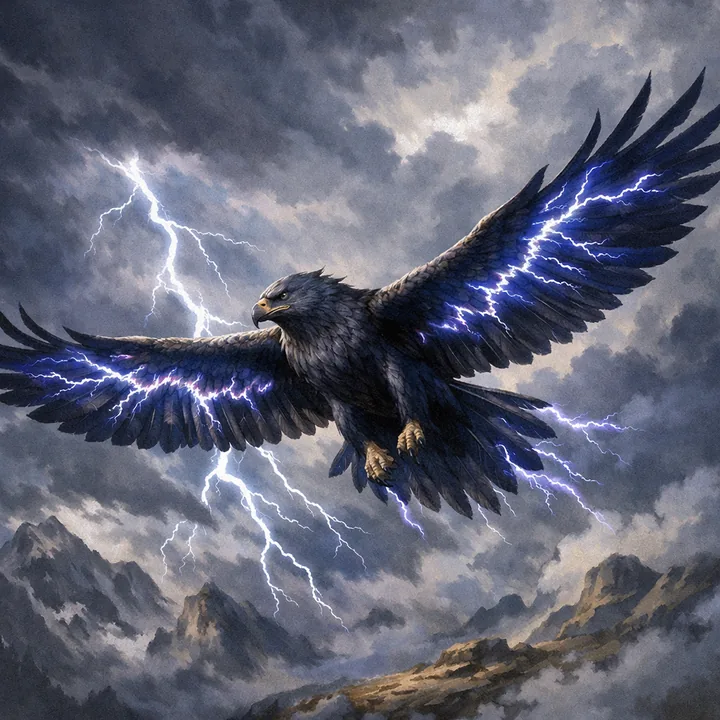
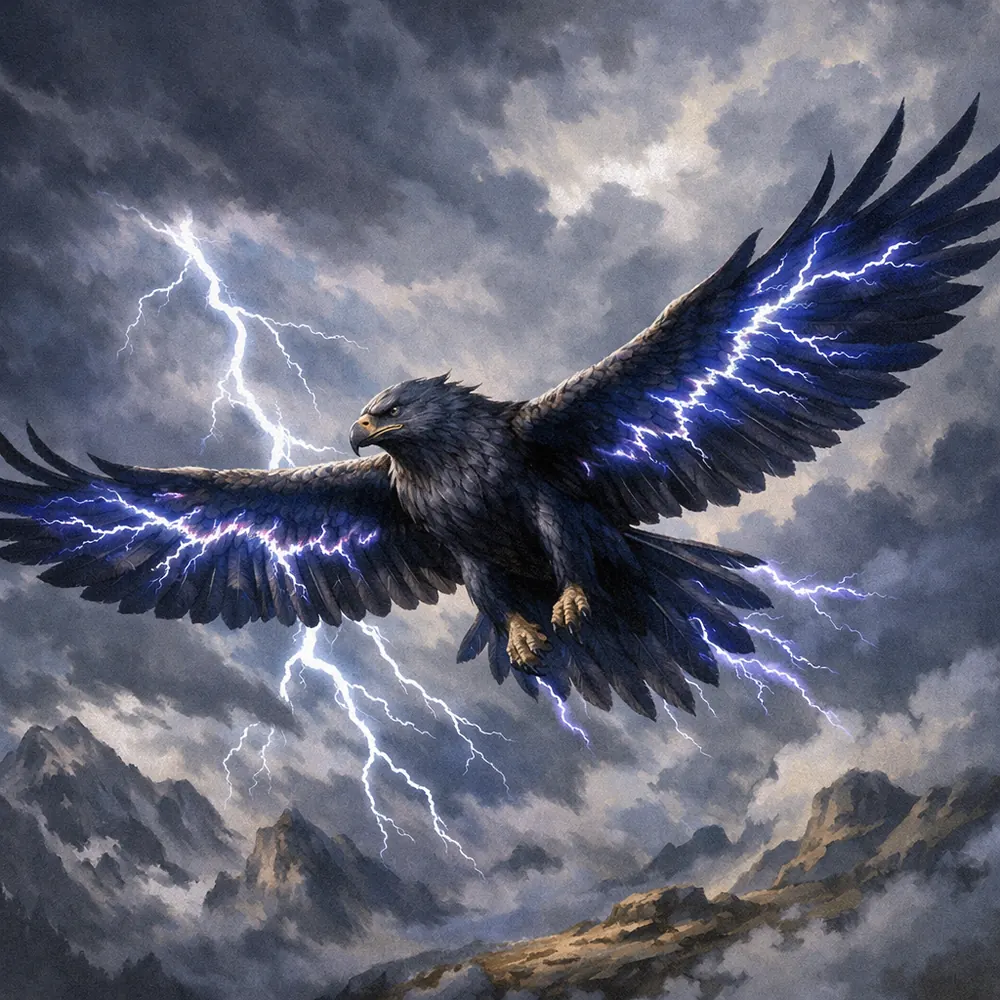
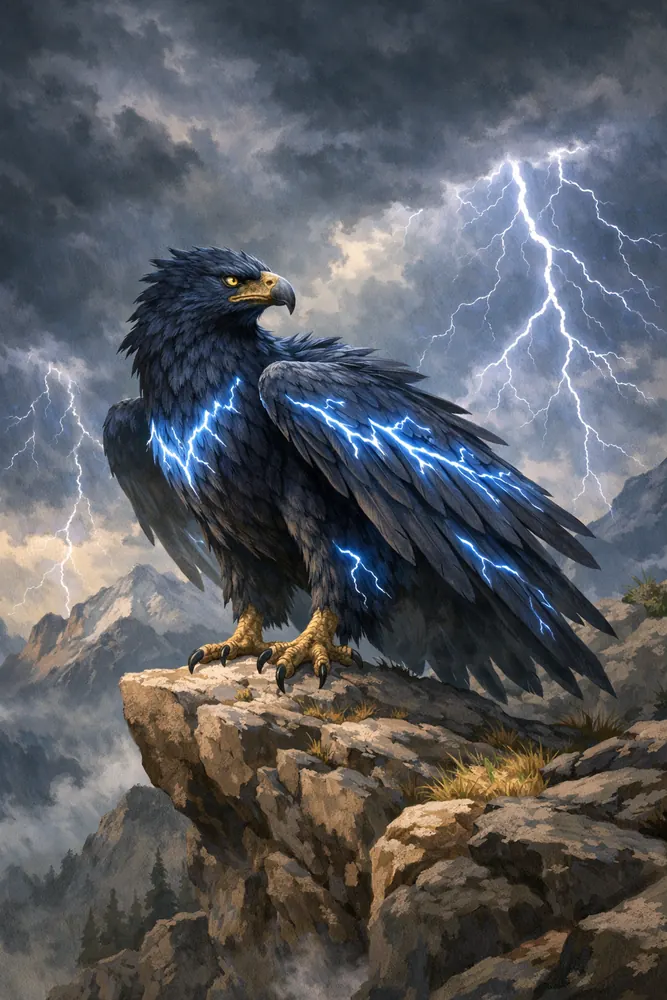
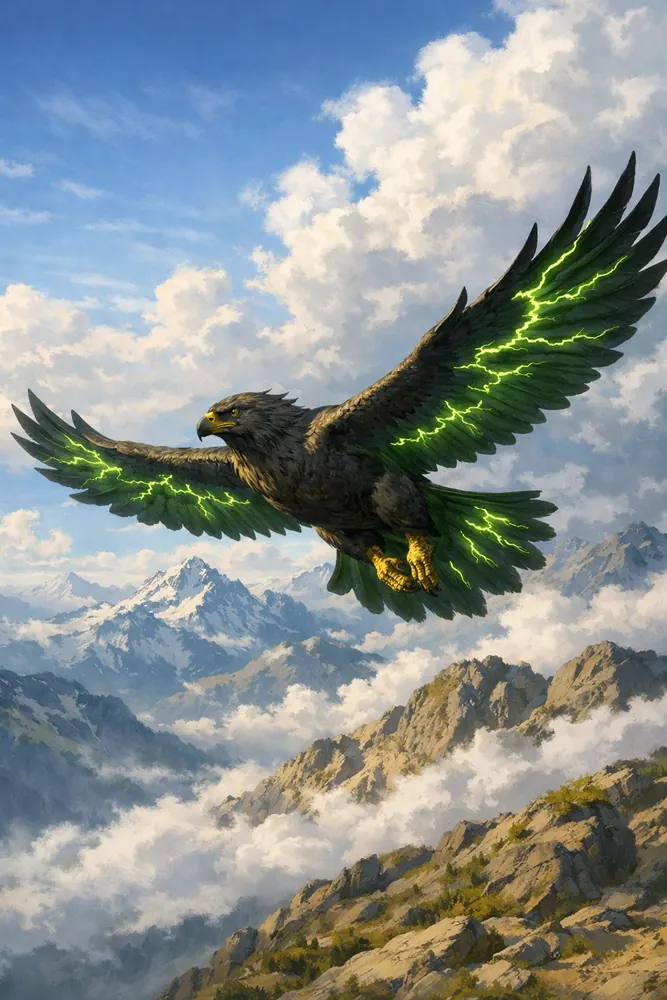
The Thunderbird is an eagle the way a cathedral is a shed. Its wingspan, by my most careful pacing of a shadow it cast across a valley, is somewhere between “enormous” and “I stopped counting and lay down in the heather.” Its feathers are the black of a wet slate roof, and along each one runs a thin vein of light that flickers like a lamp in a draught. When it blinks, you see the lightning behind its eyes before you hear anything at all.
They nest in the Storm Peaks, on ledges no sensible climber would attempt, and they seem to keep the weather the way a farmer keeps sheep. I have watched one sit motionless on a crag for an entire clear afternoon, apparently bored, until a single grey cloud wandered over the ridge. The bird lifted its head, and within the hour I was soaked to the bone and sheltering under a goat.
The Mystery of the “Empty Storm”
On three occasions I have witnessed what I call an Empty Storm: thunder rolling for an hour, the air thick and green and smelling of struck iron, and yet not a single drop of rain falls. The Thunderbird circles above it the whole time, wingbeats cracking like cannon, but nothing comes of it.
The Ventara of the High Canopy told me, with great seriousness and then a great deal of giggling, that the bird is rehearsing. A good storm, they say, must be practised, like any song. A Hesskari sailor I later met in a dockside tavern had a much simpler theory: the bird is hunting, and the thunder is meant to frighten fish to the surface of the high lakes. When I pointed out there were no lakes beneath the storm, he said that was clearly why it was so cross.
On the Matter of Bonding
Bonding with a Thunderbird is said to be so rare that most scholars at the Academy consider it a polite fiction. I am not one of them, if only because I have met someone who claims to have done it: an elderly Ventara drummer named Pell, no taller than my knee, who has played the same rolling rhythm on a skin drum atop the same peak every storm season for forty years.
Pell’s view is that you cannot impress a Thunderbird, and you certainly cannot outshout one. What it respects is steadfastness in bad weather. Anyone will stand on a mountain in the sunshine, Pell says; the bird wants to know who is still standing there when the hail starts. Her own bird, she claims, first landed beside her on the night her drum split and she kept playing on the rim.
I attempted a modest version of this myself, with a borrowed tin pot and a spoon. I lasted until the first close strike, at which point I discovered I could run downhill much faster than I had previously believed. Pell has kindly offered to teach me again next year.
Observed Magical Variations
The Thunderbirds I have seen seem to carry the temper of whichever magic their storms are made from.
Classic slate-black plumage; a crest of white feathers that stands up when lightning is near.
The most commonly sighted. Its wingbeats can be heard three valleys away, and it is fond of perching on the tallest dead tree in any forest.
Pale blue-grey feathers rimed with frost; eyes like chips of ice.
Prefers the coldest peaks. Its storms come with hailstones the size of plums, and I have seen it drink rain straight from the cloud as it flies.
Plumage so black it seems to swallow lamplight; lightning that flickers purple.
Seldom seen, which may be the point. The Arachnite say its storms arrive without warning and carry bad dreams on the wind, though they say that of a great many things.
Ambrose PenhallowLorekeeper, Midlands Grand Academy