From the Field Journal of Ambrose Penhallow
The Sun Beetle
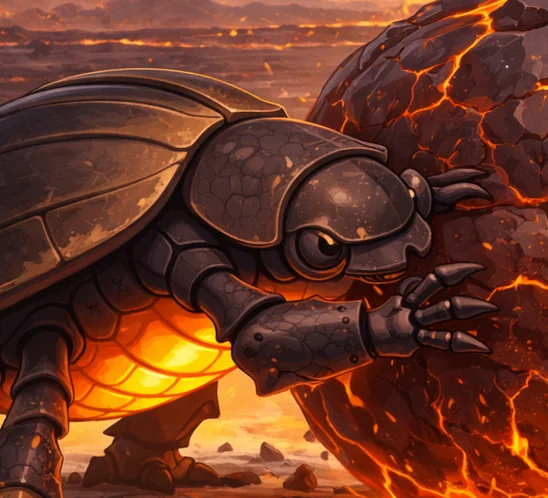
The Sun Beetle is a humble little thing to look at: broad, round-shouldered, and about the size of a loaf of bread, with a shell that shimmers in bands of copper and gold like a polished kettle. What makes it remarkable is what it pushes ahead of it. Walking backward on its hind legs, it rolls a perfect sphere of golden light, warm as a hearthstone, glowing steadily even in the blackest tunnel. It looks for all the world like a tiny, very serious labourer delivering the sun.
They live on sunny hillsides and in the caves beneath them, trundling out each morning to bask until their shells are full of light, then retreating underground to tend their orbs. Follow a line of them into the dark, and you may find yourself in a cavern lit like a summer afternoon, with mushrooms taller than you swaying gently in the warmth.
The Mystery of the “Orb Swap”
I have spent many evenings in a Sun Beetle cavern, and I noticed something peculiar. Every so often, two beetles will meet in a tunnel, stop, touch antennae, and trade orbs. There is no fighting and no obvious reason. They simply swap and carry on, as though they have exchanged letters.
A Hesskari mining foreman, who keeps a colony in the shafts beneath his lava-mountain village, was convinced these were marriage proposals. “Same as us,” he said, tapping his scaled chest. “You give someone your fire, you see if they keep it lit.” A Cephalyn pilgrim I met resting in the same caves gently disagreed, her skin shifting to a thoughtful lavender as she spoke. She believed the beetles were sharing light so that no single orb grows too dim, the way her people share the tending of a coral garden. I asked a third beetle what it thought. It rolled its orb onto my foot.
On the Matter of Bonding
A Sun Beetle will tolerate you long before it will trust you, and the line between the two is its orb. You may admire it. You may warm your hands near it. You must never touch it. I have the blister to prove that this rule is not a figure of speech.
The Hesskari are the acknowledged masters, which surprised me until I saw how they do it. They bond through their mirrors, angling a polished glass at dawn to catch the first rays of sun and casting that light down into the beetle’s tunnel. A beetle that grows used to this daily gift will begin to wait for it, and eventually follow the light back up to its source: the summoner holding the mirror.
The final step, they say, comes when the beetle rolls its orb to you and leaves it at your feet. You are not to pick it up. You are simply to sit beside it and keep it company until the beetle returns. If you have been patient, it will take its orb back and walk beside you from that day on.
Observed Magical Variations
The orb a Sun Beetle rolls seems to take on the nature of whatever magic flows through its shell.
Copper and gold shell; a bright orange orb that crackles faintly.
The classic beetle. Miners keep them for warmth and light, and they are particularly fond of sleeping in boots left near the fire.
Pearly white shell with a pale gold sheen; an orb as bright as a lamp.
Its glow is strong enough to read by. It is fiercely opposed to darkness and will chase shadows into corners as if they personally insulted it.
Mottled green shell; a dim, amber orb wrapped in tiny roots.
It buries its orb in the soil overnight, and whatever grows above it by morning is twice the size of its neighbors. Gardeners pay handsomely for one.
Ambrose PenhallowLorekeeper, Midlands Grand Academy