From the Field Journal of Ambrose Penhallow
The Blimp Bee
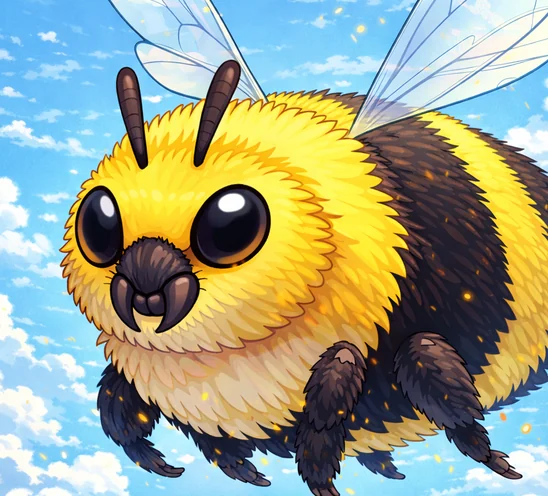
The Blimp Bee is perhaps the most agreeable creature I have yet encountered. Roughly the size of a small carriage or a stout pony-cart, they are a riot of golden fuzz and vibration. Unlike their tiny cousins, the Blimp Bee is quite comfortable on its six stout legs, often seen waddling through high-altitude meadows with a surprising, rhythmic gait.
They are the primary pollinators of the “Titan Flora,” flowers with bells the size of washbasins. A single Bee can carry two grown men upon its back, though one must be careful where they sit; the dip just behind the wings is the only place that won’t result in you being vibrated right off the chassis.
The Mystery of the “Static Anchor”
One of the most peculiar things about the Blimp Bee is its “landing” procedure. As it approaches the ground, the air around its fur begins to crackle. I’ve noticed that they don’t just land; they stick.
They seem to have a way of manipulating static electricity to anchor themselves to the petals of giant flowers or the sides of cliffs. This allows them to sleep at a ninety-degree angle without falling. However, this also means that if you are riding one during a dry spell, your hair will likely stand straight up for several hours after dismounting. I have yet to find a tonic that cures “Bee-Scalp.”
On the Matter of Bonding
These creatures have no interest in dominance. If you try to “break” a Blimp Bee like a horse, it will simply tuck its legs in, sit on you, and wait for you to stop being annoying.
The secret to their cooperation is The Hum. They are incredibly sensitive to sound. I’ve found that if you sit near one and match your breathing to the low-frequency thrum of its thorax, it begins to accept you as part of the “hive.” Once bonded, they are intensely loyal in a quiet, bumbling sort of way. They won’t fight for you (they aren’t built for it), but they will navigate the thickest mountain fog to get you home, guided by a sense of direction that seems to pull them toward “warmth and safety.”
Observed Magical Variations
The Blimp Bee’s temperament and flight patterns seem to shift based on the specific “color” of magic they’ve been harvesting.
Vibrant orange and gold; exceptionally thick “ruff” around the neck.
The classic mount. They are the hardiest of the bunch and can fly for a full day without needing to “refuel” on nectar.
Deep purple-black fuzz; larger, more sensitive antennae.
These bees prefer the nectar of night-blooming jasmine. They are much quieter and their wings emit a soft, bioluminescent glow that helps passengers see the ground below.
Pure white with silver bands; wings that look like etched ice.
Found in the higher peaks. They don’t seem to mind the cold at all. In fact, they generate so much internal heat that sitting on one is like hugging a warm stove. Highly recommended for winter travel.
Ambrose PenhallowLorekeeper, Midlands Grand Academy