From the Field Journal of Ambrose Penhallow
The Skyvader
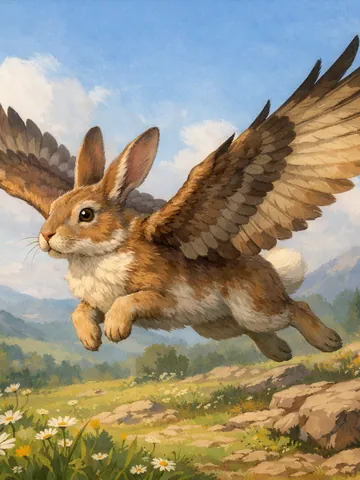
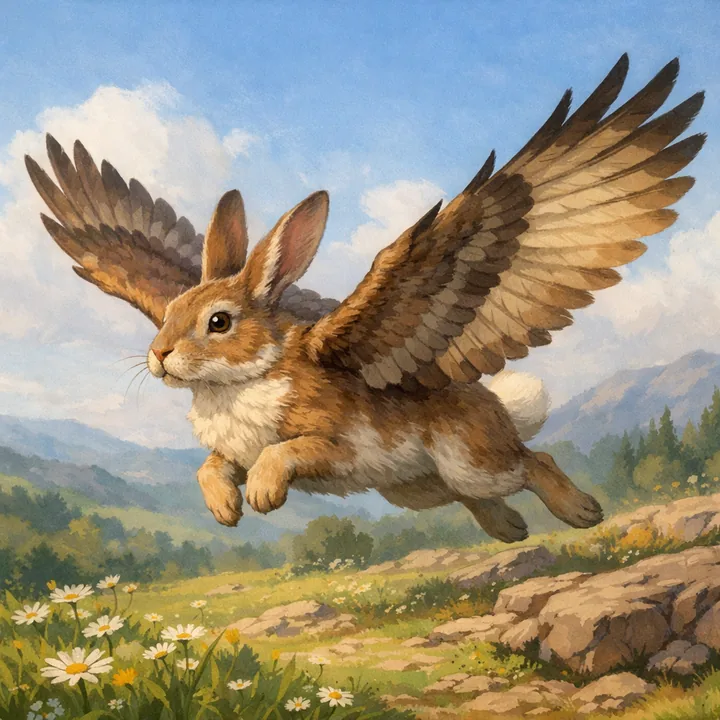
The Skyvader looks, for the first few moments, like an ordinary brown hare going about its ordinary brown business in the long grass. Then something spooks it, it bolts, and just as you think you have the measure of it, two broad hawk wings unfold from its shoulders and the hare simply leaves the ground. I have seen hounds skid to a stop in disbelief. I have done the same.
They live on the open Highland meadows, where the wind is constant and the grass grows to a man’s knee. They spend most of their time on foot, grazing and grooming, and only fly when they must; but when they do, they skim so low that the seed heads part around them like water around a boat.
The Mystery of the “Standing Watch”
On certain evenings, every Skyvader on a hillside will sit bolt upright on its hind legs, wings half open, and stare in the same direction for minutes at a time. There is never anything there. I have followed their gaze with my best Academy spyglass and seen only cloud.
A Centaur of the Brightmane clan, who graze their herds on the same hills, told me with absolute certainty that the hares are watching for the old storm-eagles that hunted them before the Great Split, and that “a hare’s memory is longer than a scholar’s beard.” A shepherd’s grandmother, on the other hand, told me they are checking the weather, and that if they all face west you should bring in the washing. I have since tested this. She was right about the washing.
On the Matter of Bonding
A wild Skyvader is the most nervous animal I have ever met. A dropped spoon will send it a mile. And yet a bonded one is utterly fearless in the air; I have watched a little girl’s Skyvader fly straight through a hailstorm to fetch the ribbon she had lost.
The experts here are not the Centaurs, nor any learned order, but the Human children of the Highland villages. Every spring they hold the Skyvader races, and the bonds are formed in the weeks before. The method, as it was explained to me by a very serious nine-year-old named Tamsin, is that you must lie down in the meadow, completely flat, and let the hare decide that you are a part of the ground. Then you must lose a race to it. On purpose. Several times. “They like to win,” she said. “And they like it when you clap.”
When the races finally come, the winning Skyvader is fed clover and fussed over for weeks, and the losing ones are fussed over nearly as much. I asked Tamsin whether this was fair. She looked at me as though I had asked whether the sky was blue.
Observed Magical Variations
The Highland children have names for every color of Skyvader, but these three turn up at the spring races most often.
Tawny brown with speckled hawk wings; ears that stream back flat.
The classic racer. It uses little gusts of sky magic to turn in mid-air, and wins most races by simply changing its mind about where the finish line is.
Russet coat; stubby, rounded wings.
Barely flies. Prefers to vanish into tall grass and stay there. It never wins races but it has never once been caught by a fox, which is its own sort of victory.
Pale gold fur; wingtips that catch the sunrise.
Only flies at first light. The children say if one crosses your path at dawn you will have a good day; one crossed mine and I immediately fell in a stream.
Ambrose PenhallowLorekeeper, Midlands Grand Academy