From the Field Journal of Ambrose Penhallow
The Monstrous Toad
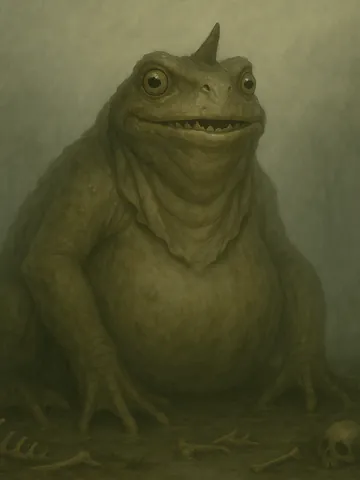
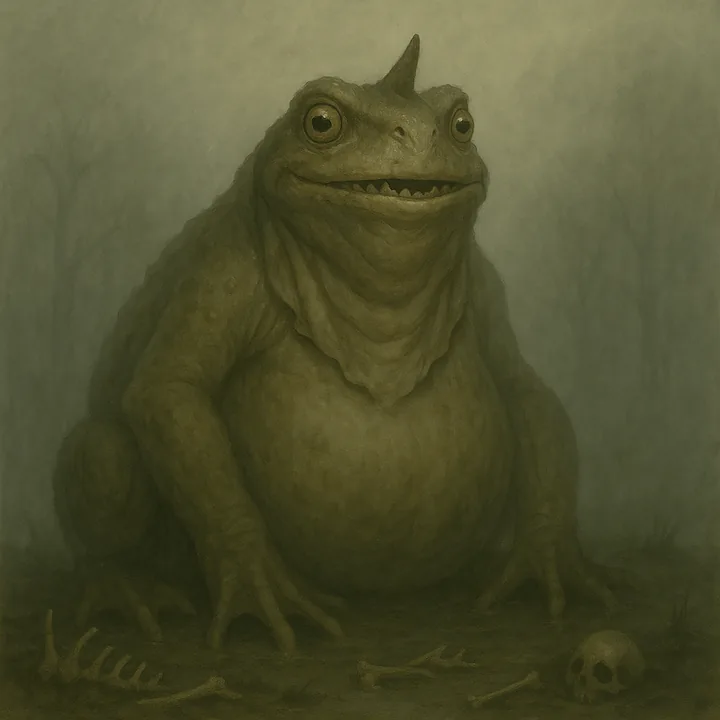
Imagine a toad. Now imagine that toad has eaten a cottage, grown a single crooked horn on its brow, and settled down to digest it for a hundred years. That is the Monstrous Toad. Its hide is the color of old pond water, sagging in great folds beneath the chin, and its mouth sits fixed in a thin, toothy smile that I can only describe as knowing. It is not a friendly smile. It is the smile of someone who has already won the argument you have not started yet.
They live half-sunk in the black water of the Shadowmere Bogs, where the reeds grow so thick and the air so still that sound seems to drown before it reaches you. I spent nine days camped within sight of one. It did not move. A heron landed on its head, considered its life choices, and left. The scattered bones around its feet were, I was assured, “mostly old.”
The Mystery of the “Counting Bones”
On my sixth morning I noticed that the bones around the Toad had been rearranged overnight. Not scattered, mind you: sorted. Ribs in one heap, skulls in a neat little row facing outward, finger-bones laid end to end like a tally. I had not heard so much as a ripple.
The Wika of the floating villages told me, quite seriously from behind their painted masks, that the Toad counts the dead of the bog each night so that their spirits know they have been remembered. An Arachnite silk-trader passing through scoffed at this. She tapped her third eye and said the Toad keeps a ledger: every bone is a debt, and every debt is a traveler who failed to leave an offering. When I asked which kind of bone I would be, she simply smiled and went on her way. I left an offering that afternoon. It was half my cheese ration, and I regret nothing.
On the Matter of Bonding
Here I must be honest: I did not bond with a Monstrous Toad, and I am not sure anyone truly “bonds” with one in the ordinary sense. One is permitted by it. The difference is subtle but, I am told, very important.
The Arachnite are the closest thing to experts. Their method is maddeningly slow. You must return to the same Toad at the same hour, leaving the same offering in the same spot, for as long as it takes the creature to decide you are part of the bog’s furniture. One weaver claimed it took her eleven years. Another said three days, but admitted she had brought a very good silk scarf.
The Hags, naturally, have a faster way, involving rune-scratched stones and something I will not describe in a family journal. A Wika elder warned me that a Toad bound this way never forgets the insult. The bog, she said, has a long memory, and the Toad is the bog’s memory given a body. I wrote that down because it sounded wise, and also because the Toad was staring at me while she said it.
Observed Magical Variations
Every Monstrous Toad I have seen looks as though it has been sitting there since before the map was drawn, but the water they sit in changes them considerably.
Murky olive hide streaked with black; a single long horn hooked like a reaping blade.
The classic Shadowmere giant. The fog it exhales smells of rotten honey, and I lost a whole afternoon to it without noticing.
So encrusted with moss, ferns and small mushrooms that it is easily mistaken for a hillock.
I sat on one for a quarter of an hour before it swallowed a passing goose. Locals use them as boundary markers, which seems unwise.
Pale, almost waxen skin; a horn that glows a sickly yellow in the dark.
Lures moths and lost travelers alike. The Wika insist it leads the lost safely home, though they could not name anyone it had actually led home.
Ambrose PenhallowLorekeeper, Midlands Grand Academy