From the Field Journal of Ambrose Penhallow
The Cockatrice
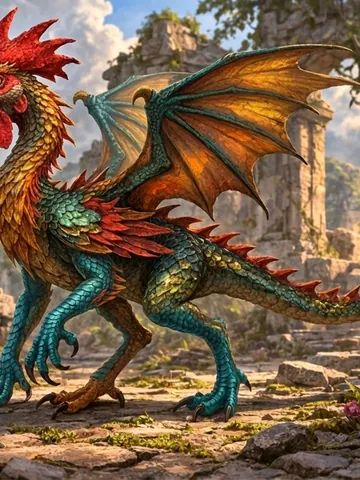
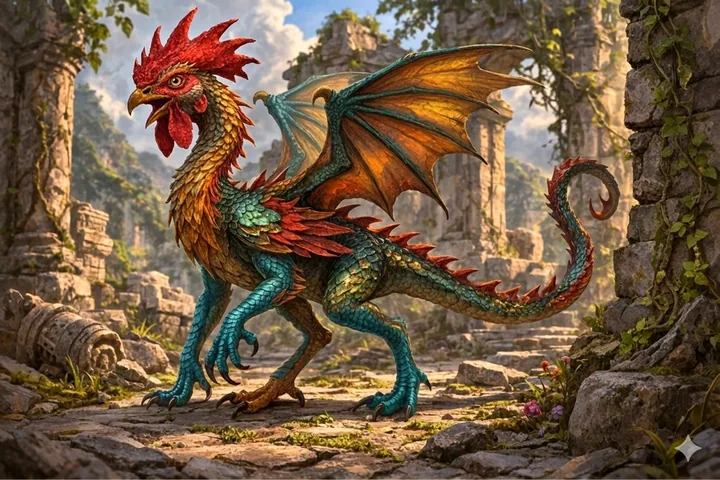
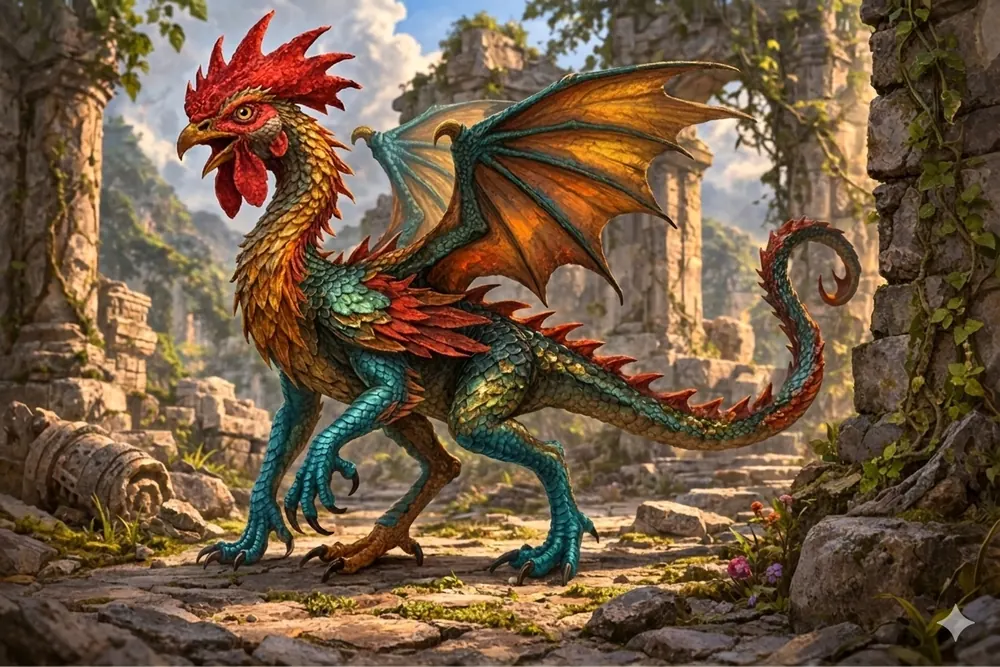
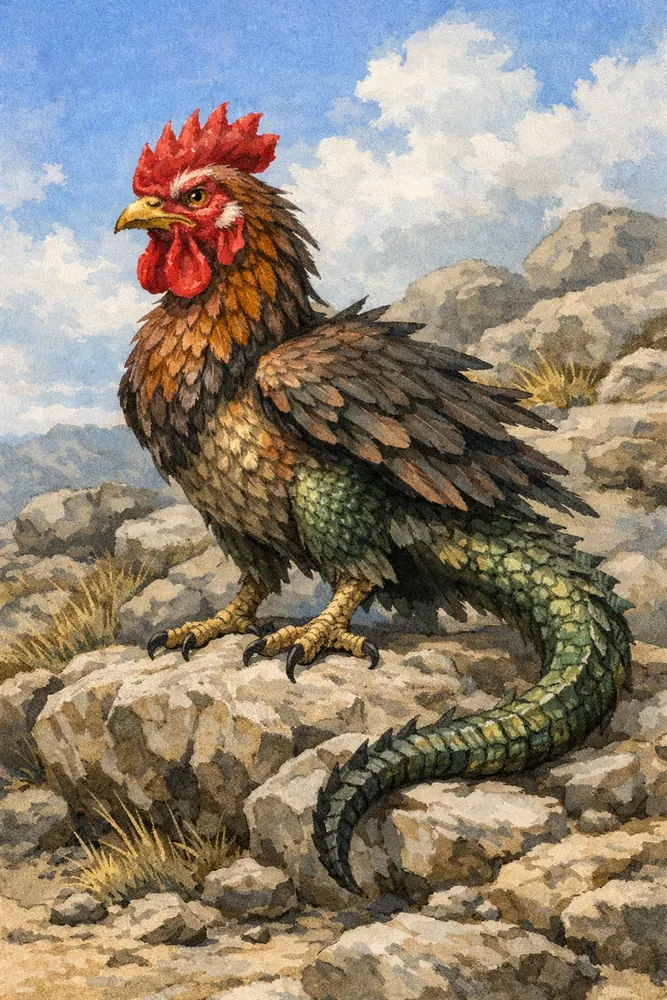
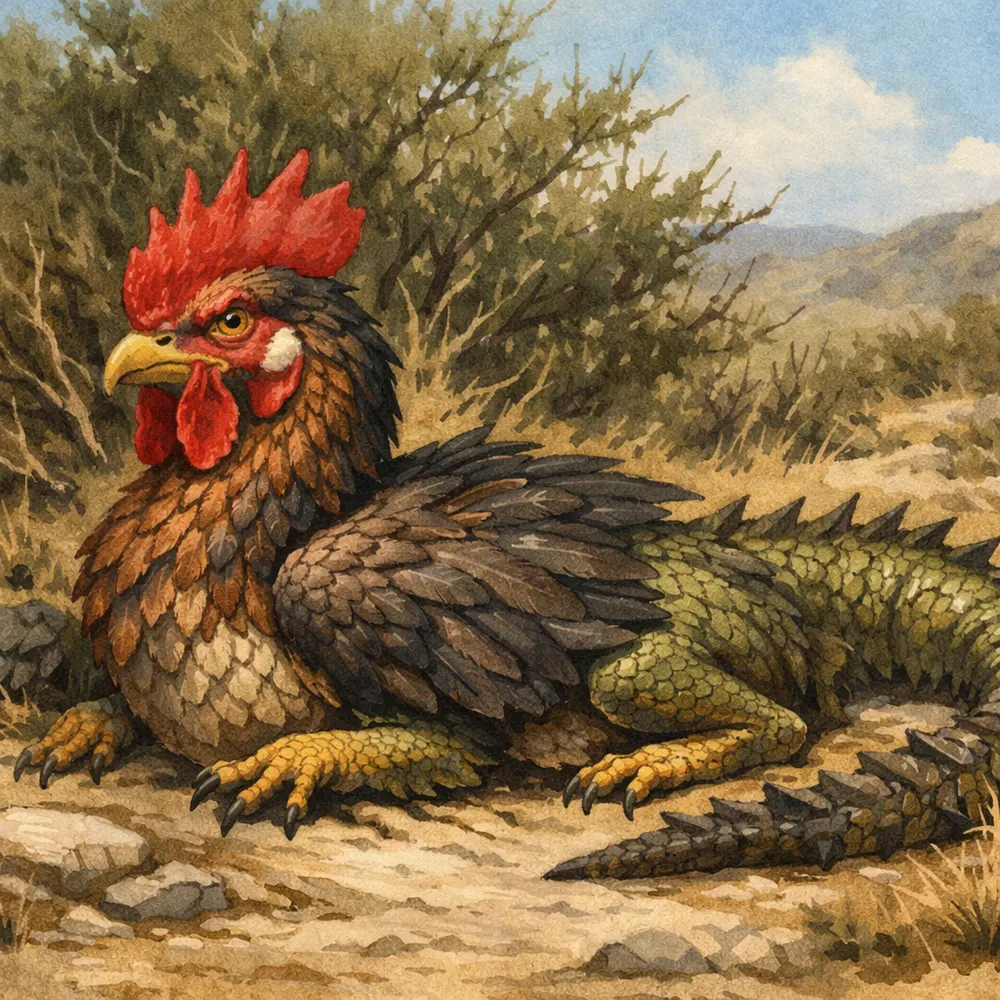
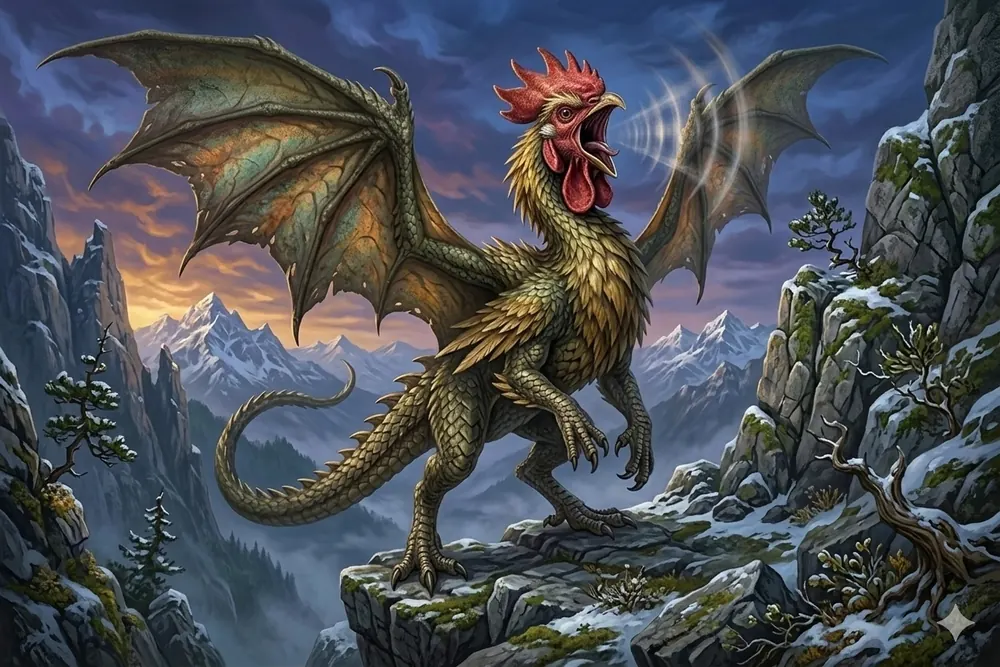
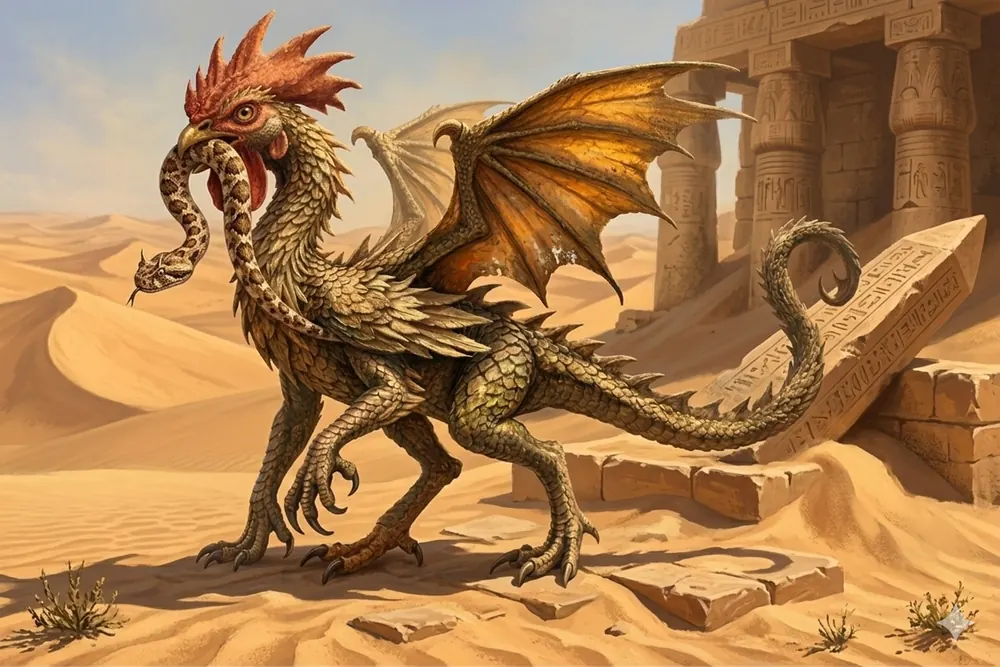
Picture the proudest rooster in the most prosperous farmyard you can imagine. Now give it the scaled, jewel-green body of a small wyvern, a pair of copper-veined leathery wings, a tail lined with blood-red spines, and the general disposition of a tax collector. That is the Cockatrice. Its crest is a blazing crown of scarlet feathers that fades into gold and then into overlapping scales somewhere around the shoulders. It struts. I have never seen it do anything else.
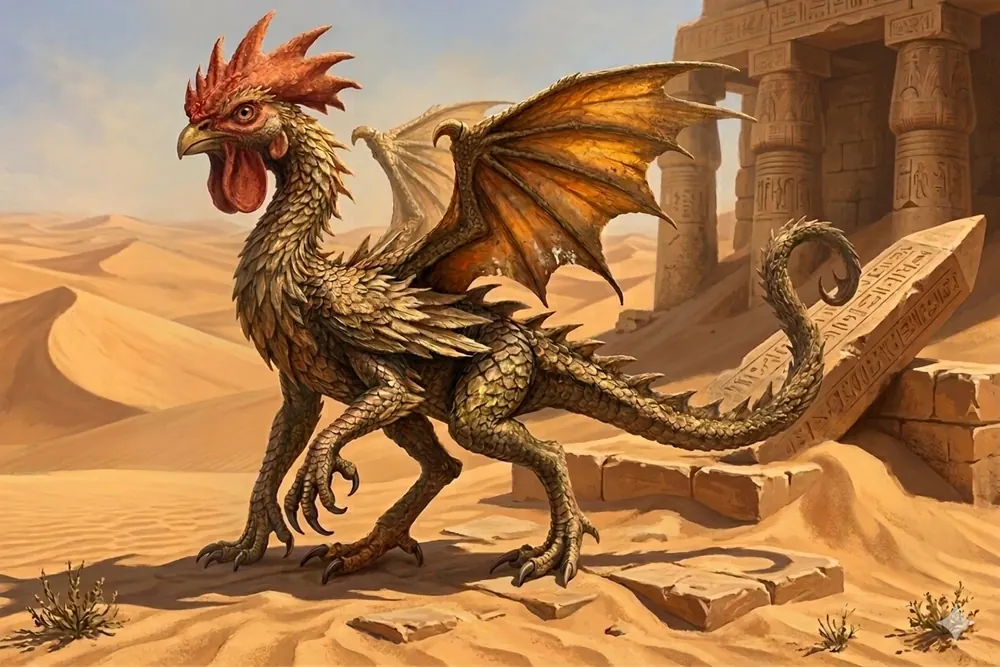
They make their homes in the desert ruins and dry highlands, where the old stones bake in the sun and little else dares to settle. A Cockatrice will claim a fallen temple or a crumbling wall and patrol it from dawn until dusk, crowing at intervals as if to remind the world that the deed is still in its name.
The Mystery of the “Crooked Crow”
Every Cockatrice crows at dawn, as one would expect. What I cannot explain is the second crow, usually somewhere around mid-afternoon, which is shorter, flatter and always directed at a particular stone. Always the same stone. I watched one Cockatrice crow at a single cracked pillar every afternoon for a month.
The Hesskari caravan-masters believe the stone holds the reflection of a rival, an echo left in the rock by some long-dead Cockatrice, and that the living bird is simply reminding it who is in charge now. An Arachnite prophet I met at an oasis offered a stranger idea: she said the stone is not a rival at all, but a grave, and that the second crow is a kind of mourning. She refused to say whose grave. She did, however, foretell that I would be pecked within the week. She was right.
On the Matter of Bonding
You do not bond with a Cockatrice by winning its affection. You bond with one by winning its respect, and the only way to do that is to stand your ground while it glares at you.
The Hesskari are the masters here, which surprised me, given their habit of chasing Cockatrices away with mirrors. But a Hesskari pirate-turned-trader explained it: the mirror is a test. A Cockatrice that sulks off at its own reflection is too vain to bond. The ones that stare back into the mirror, the ones that hold their own gaze without flinching, are the ones worth knowing. The summoner then meets that stare, through the stiffening and the creeping cold in the knees, for as long as the bird does. Blink first and you have lost.
I tried. I lasted eleven seconds before my legs locked and I toppled gently sideways into the sand. The Cockatrice crowed in triumph, walked twice around me, and then pecked me on the ear. The Hesskari said that was a sign of affection. My ear disagreed.
Observed Magical Variations
All Cockatrices share the same commanding strut, but the ruins they rule leave their mark on the color of their crests and the strength of their stare.
Emerald scales, scarlet crest, wings veined with copper and amber.
The common ruin-dweller. Its stare stiffens joints like a cold morning. Polishes its spurs on temple steps.
Charcoal-black scales with a crest of flickering orange feathers that genuinely smolder.
Haunts the lava fields near Hesskari mountain towns. Its dawn crow is preceded by a little puff of smoke, which it seems very proud of.
Dull purple-grey scales; a crest of ragged black plumes; eyes that glint red.
Rarely seen and much feared. Its stare is said to leave a chill that lingers for days. Its spurs carry a mild venom.
Ambrose PenhallowLorekeeper, Midlands Grand Academy